
How to Create WhatsApp Templates
Cue allows you to send WhatsApp-approved template messages to your customers as a broadcast. This lets you reach out to customers without them needing to engage with the account first.
In this guide, we will show you how to create and submit a WhatsApp template for approval. We'll also explain how to customise your WhatsApp template using variables, media, headers and more.
Template types
Cue supports two types of WhatsApp templates:
- Standard templates — a single message with an optional header, body text, buttons, and footer. Covered in this guide.
- Carousel templates — a swipeable, multi-card message with 2–10 cards, each containing a media header, optional body text, and buttons. Limited to the Marketing category. See our guide on How to create and send a Carousel Template for details.
Creating your template
1. Click Tools (tab on the left-hand side menu)
2. Click Go to templates
3. Click Create Template
You should now be on the template creation page:
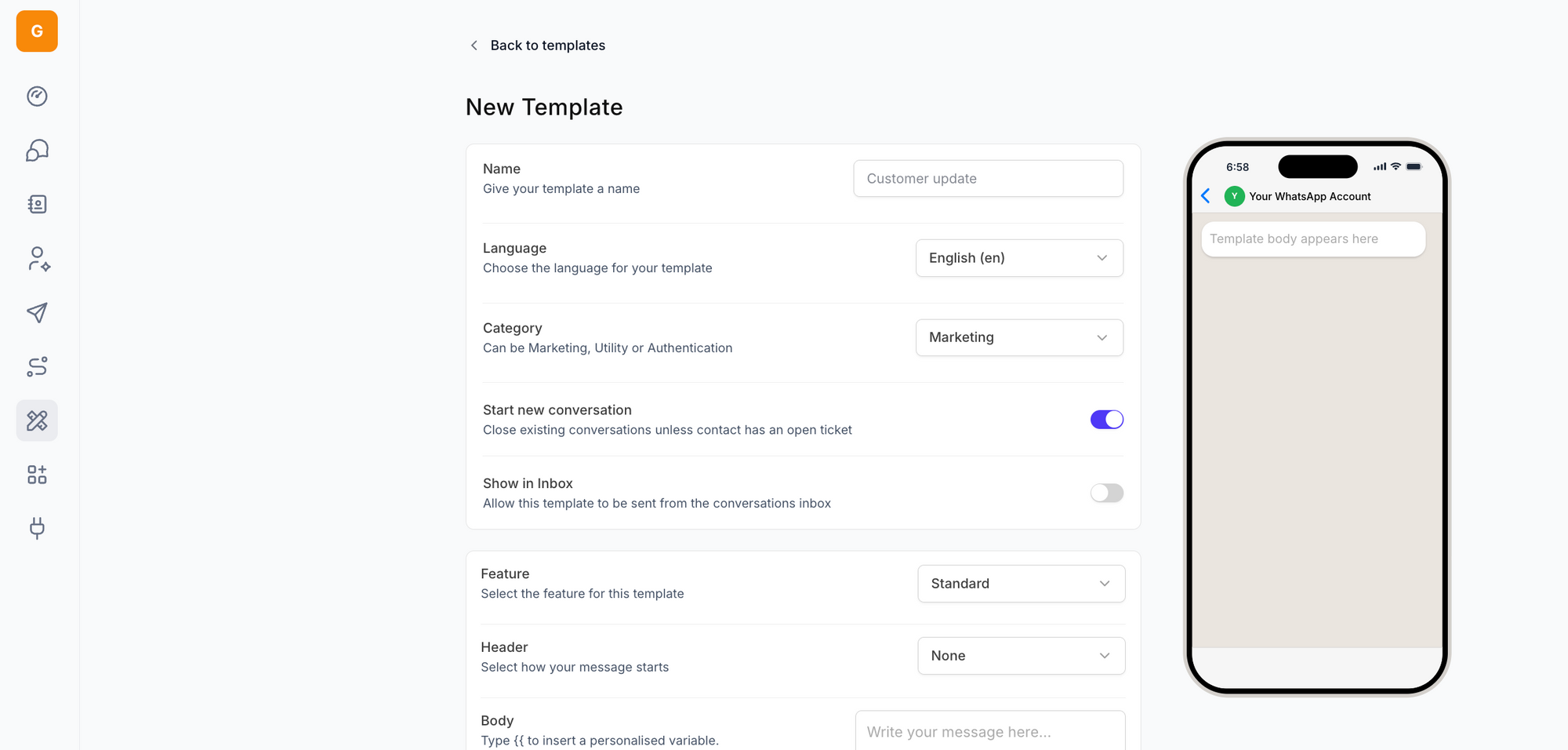
Name: Provide a name for your template
Language: Select the language you would like to use for the broadcast.
Category: WhatsApp needs you to categorise your templates.
- Marketing — Share promotions, updates, invitations etc. for customers to respond or take action.
- Utility — Requests or transactions, e.g., confirming transactions, updating on ongoing transactions or notifying customers after a purchase.
- Authentication — Verify users using one-time passcodes. At creation, you can select to allow a predetermined security recommendation, contact number and configure the expiry time for the passcode.
Session Behaviour Options
- Start new conversation (Default): When this template is sent to a contact who is currently in an active session (e.g., interacting with a flow or AI Agent), the existing session will be closed and a new session will be opened. Should this option be deselected, the existing conversation will continue - when this template is sent to a contact who is currently in an active session, the message will be delivered without interrupting their session. The contact can continue their existing conversation.
- Show in Inbox: Makes the template available for use in the Inbox. Allows you to, in an open conversation, click 'Send a WhatsApp Template' which opens the template selection modal, or using the template to initiate a new single-send conversation.
Header: Add a header to your WhatsApp template. Headers are available for Marketing and Utility templates only.
- Text: Character limit of 60 characters including spaces.
- Image: JPG, JPEG or PNG format with a max size of 5 MB.
- Video: MP4 or MOV with a max size of 16 MB.
- Document: PDF, DOCX, etc. with a maximum size of 100 MB.
When your typing cursor is in the template text field you can click the button that says Insert Variable to include personalised variables in your template, e.g., {name}, {date}, {time}, etc.
See our guide on Sending WhatsApp Broadcasts for more information on how to use these variables in your broadcast file.
Call to Action Buttons: Add a max of 3 buttons per template with a character limit of 25 characters per button.
- Quick Reply — a pre-defined response option
- Visit Website — a URL link button
- Call Us — a phone number button
Footer: Insert an optional footer at the bottom of your message copy.
Now that you have a complete WhatsApp template, click Create to submit to Meta for approval. You can send out your WhatsApp template once the status changes from 'Preparing' to 'Approved'.
Template guidelines
Use the following tips to create effective message templates that align with WhatsApp's policies:
- Template can't start or end with a variable
- Variables can't be sequential, e.g. Hey {name}, {message}
- Check for spelling or grammatical errors
- Don't duplicate an existing template
- Language needs to match content
- Don't include content that violates WhatsApp's Business Policy